
Industrial pumps aren’t supposed to stop. They’re expected to run around the clock, moving aggressive chemicals, pharmaceutical ingredients, food-grade liquids, wastewater, or high-pressure process fluids without missing a beat. And whether they actually hold up to that expectation usually comes down to one part nobody thinks about until it fails: the rubber diaphragm.
It’s easy to assume a diaphragm’s job is just to keep two chambers separated. It’s not. A well-built industrial pump diaphragm is doing a lot more — controlling pressure, holding a reliable seal, absorbing constant flexing, and keeping fluid movement steady cycle after cycle. When it’s working, the whole pumping system runs cleaner and more efficiently. When it’s not, you’re looking at downtime, contamination, leaks, and maintenance bills that show up faster than they should.
For plant engineers, OEM manufacturers, and maintenance teams across the U.S., picking a rubber diaphragm isn’t just a parts-replacement decision. It’s a decision that affects reliability, efficiency, and how much you’ll spend on this equipment over the next five years.
This guide walks through how rubber diaphragms actually improve pump performance, what tends to cause them to fail, how to think about material selection, and why custom-engineered diaphragms tend to outperform anything off a shelf.
Why Pump Performance Really Comes Down to the Diaphragm
Every industrial pumping system is a collection of parts working together to hold pressure, flow rate, and process stability steady. Of all those parts, the diaphragm takes on some of the heaviest mechanical stress.
Every single cycle, it flexes — and it has to keep flexing while still holding a leak-tight barrier between the pumped media and the drive mechanism behind it. Depending on the application, that diaphragm might flex millions of times over its working life without ever getting a break.
Once it starts losing flexibility, cracking, or breaking down chemically, here’s what follows:
- Pumping efficiency drops
- Pressure starts fluctuating
- You get leakage
- Product contamination becomes a real risk
- Maintenance gets more frequent
- Production stops without warning
- Operating costs climb
That’s the whole reason high-quality industrial rubber diaphragms matter so much in applications where consistency isn’t optional.
What a Rubber Diaphragm Actually Is
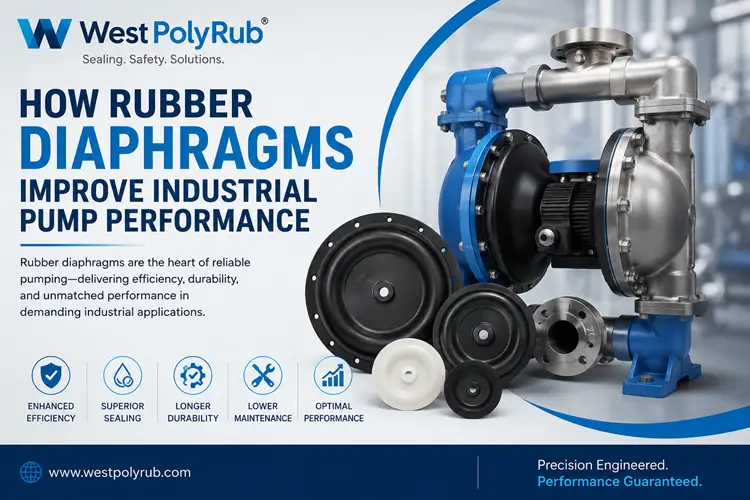
At its core, a rubber diaphragm is a flexible elastomeric membrane built to transfer pressure while sealing off two chambers from each other. Unlike a static seal that sits still, a diaphragm is in constant motion during operation — which is exactly why material selection, reinforcement, and manufacturing quality matter so much here. This isn’t a “close enough” component.
You’ll find rubber diaphragms doing work inside:
- Air-operated double-diaphragm (AODD) pumps
- Metering pumps
- Chemical dosing systems
- Pressure regulators
- Pneumatic actuators
- Control valves
- Vacuum equipment
- Fluid transfer systems
Because they’re flexing continuously, they need to combine flexibility, fatigue resistance, chemical compatibility, and dimensional stability all at once — not just one or two of those.
How Rubber Diaphragms Actually Improve Pump Performance
They hold pressure and flow steady. A pump diaphragm’s core job is keeping pressure stable through every single cycle. A precision-molded diaphragm flexes evenly, giving you smooth suction and discharge with minimal pressure loss — which matters a lot in dosing systems and precision fluid transfer, where accuracy is the whole point. Stable pressure also means less vibration, less stress on downstream equipment, and a more consistent process overall.
They cut down on leakage and product loss. Leakage is one of the most common reasons pumps underperform. A properly engineered diaphragm forms a reliable dynamic seal that keeps fluid from getting into the actuator or escaping into the surrounding environment — which matters enormously when you’re handling hazardous chemicals, pharmaceutical ingredients, food products, high-purity water, or corrosive media. Good sealing means less waste and an easier time staying on the right side of environmental and safety compliance.
They improve energy efficiency. Pumps use a lot of energy over their lifetime, and a stiff, damaged, or poorly specified diaphragm makes the pump work harder to maintain the same flow and pressure. Fabric reinforced rubber diaphragm hold their flexibility across millions of cycles, which means less wasted energy and better overall equipment efficiency — a difference that adds up fast on an energy bill.
They extend the life of the whole system. Replacing a pump is expensive. Replacing a diaphragm is not — but only if you catch the failure before it damages something else. The right diaphragm material reduces wear on the pump housing, pistons, valve assemblies, pressure regulators, and actuators around it. A longer-lasting diaphragm means a longer-lasting pump and lower costs over the equipment’s full life.
They help you avoid the surprise shutdowns. Pump failures rarely come out of nowhere — there are usually warning signs first: reduced discharge pressure, irregular flow, air leaking, fluid contamination, more vibration than usual, a slower response time. Installing a custom rubber diaphragm engineered for your actual operating conditions makes those symptoms easier to catch early and supports a real predictive maintenance program instead of reactive firefighting.
Why Fabric Reinforced Diaphragms Tend to Outperform Standard Ones
A lot of industrial applications need more than a standard molded piece of rubber can give them. Fabric reinforced rubber diaphragm build in engineered reinforcement layers that meaningfully improve mechanical performance — higher burst strength, better dimensional stability, less stretching, stronger fatigue resistance, longer service life, better pressure handling, and more reliability under constant cycling.
That’s why you’ll see these specifically in high-pressure pumps, regulators, pneumatic systems, and OEM equipment that can’t afford to underperform.
Picking the Right Diaphragm Material
This is one of the decisions that’s easy to get wrong and expensive to get wrong. Different elastomers are built for different jobs:
| Material | Best For |
| EPDM | Water, steam, and weather resistance |
| Silicone | Food processing, medical equipment, and high temperatures |
| Nitrile (NBR) | Oils, fuels, hydraulic fluids |
| FKM (Viton®) | Aggressive chemicals and high temperatures |
| Natural Rubber | Excellent flexibility and abrasion resistance |
| PTFE Bonded Diaphragms | Highly corrosive chemical processing |
Before you land on a material, work through: operating temperature, chemical compatibility, pressure range, flex cycle frequency, abrasion levels, and any regulatory requirements like FDA compliance.
What Actually Causes Diaphragm Failure
Even a premium diaphragm will fail if it wasn’t specified correctly in the first place. The usual culprits:
- The wrong elastomer for the job
- Chemical attack from incompatible media
- Running hotter than the material can handle
- Abrasive media is wearing it down
- Overpressure
- Fabric wrinkles introduced during manufacturing
- Weak bonding between the rubber and its reinforcement
- Just poor molding quality overall
A manufacturer with in-house compound development, precision tooling, and real burst testing catches most of these risks before the part ever ships.
Who’s Actually Relying on These Diaphragms
Chemical processing — needs diaphragms that can shrug off aggressive media while still sealing reliably.
Pharmaceutical manufacturing — FDA-compliant diaphragms protect product purity and keep hygienic processing standards intact.
Food & beverage — food-grade silicone and EPDM diaphragms deliver reliable performance while meeting sanitation requirements.
Water & wastewater treatment — diaphragms give dosing pumps and treatment systems the flow accuracy they depend on.
Oil & gas — high-pressure applications here demand reinforced construction that can handle a genuinely demanding environment.
OEM equipment manufacturing — custom diaphragms let manufacturers fine-tune performance, reliability, and what sets their equipment apart.
Why OEMs Go Custom Instead of Standard
Standard parts have limits. They can’t solve every engineering problem, and pretending otherwise usually costs more down the line. Custom diaphragms let OEMs dial in stroke characteristics, pressure response, sealing geometry, material compatibility, bonding options, and equipment footprint — all the details that actually determine whether a part performs the way it’s supposed to.
Manufacturers like Western Polyrub India Pvt. Ltd. specialize in exactly this — building custom-engineered rubber diaphragms with fabric reinforcement, PTFE bonding, metal bonding, and elastomer formulations tailored to specific industrial applications. In-house tooling, compound development, and real quality testing are what let OEMs get reliable, repeatable performance out of demanding environments instead of hoping for the best.
Frequently Asked Questions
What does a rubber diaphragm do in an industrial pump? It transfers pressure while forming a flexible seal between chambers, letting fluid move through the system without leaking into the mechanical drive.
How long does a pump diaphragm last? It depends on the material, operating pressure, temperature, chemical exposure, and how often it cycles — but a properly specified, high-quality diaphragm can reliably handle millions of cycles.
What’s the best material for a pump diaphragm? There isn’t one universal answer. EPDM, NBR, silicone, FKM, and PTFE-bonded diaphragms each perform best in different conditions — the right choice depends on your application’s temperature, media, and pressure requirements.
Why do industrial pump diaphragms fail? Usually, it’s the wrong material, chemical incompatibility, too much pressure or heat, abrasive media, poor manufacturing quality, or fatigue from repeated flexing.
What are fabric-reinforced rubber diaphragms? They’re diaphragms built with reinforcement fabric embedded in the elastomer, which boosts burst strength, dimensional stability, and fatigue resistance — ideal when the application is demanding.
Can rubber diaphragms be custom-engineered? Yes — custom diaphragms can be built with specific elastomers, reinforcement fabrics, bonding methods, and geometries to match OEM or process-specific requirements exactly.
Get More Out of Your Pumps With the Right Diaphragm
A quality rubber diaphragm isn’t just another part on the assembly list — it directly shapes how efficient your pump is, how reliable your equipment stays, what your maintenance costs look like, and how much uptime you actually get. Getting the material, reinforcement, and design right for your application can meaningfully extend service life and cut down on unplanned downtime.
Need a custom or fabric-reinforced rubber diaphragm built for a demanding application? Western Polyrub India Pvt. Ltd. brings over 30 years of experience in engineering and manufacturing precision rubber diaphragms for OEMs and industrial users worldwide. Get in touch to talk through a solution built around your exact operating conditions.