
If you run a manufacturing plant in the U.S., you already know how much a single leaky seal can cost you. Downtime, contamination, wasted product, safety incidents — it all traces back, more often than people expect, to one overlooked component: the seal.
Not the big, obvious parts of the machine the seal.
Specifically, the inflatable seal.
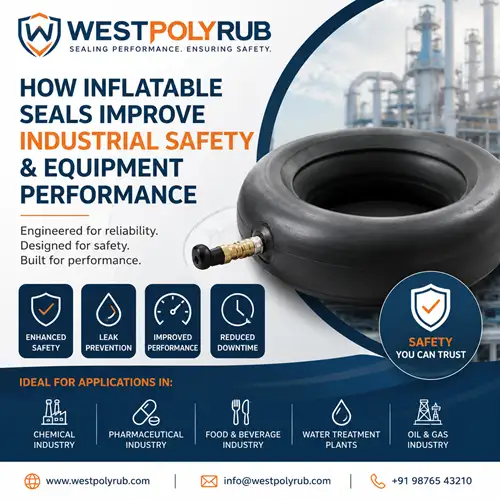
Here’s what makes it different from the static gasket sitting in most equipment today: it only does its job when it needs to. Feed it compressed air and it expands to form a tight, even seal against the surface. Cut the air, and it drops back down, out of the way, so nothing rubs, drags, or wears out from constant contact.
That one design choice — sealing on demand instead of sealing all the time — is why inflatable seals show up so often in equipment that has to run reliably, stay clean, and hold pressure for years without babysitting.
If you’re speccing new OEM equipment or trying to figure out why an existing machine keeps needing seal replacements, this is worth five minutes of your time.
Why the Old Way of Sealing Keeps Failing You
A lot of plants are still running compression gaskets or fixed rubber seals — parts that were never really built for equipment that opens and closes hundreds or thousands of times a day.
The symptoms show up fast:
- Air leaking past the seal
- Dust or particulate getting where it shouldn’t
- Fluid seepage
- Uneven pressure across the sealing surface
- Friction wearing down the seal (and the door, and the actuator)
- Seals that need replacing far sooner than they should
- Maintenance shutdowns that weren’t on the schedule
None of that stays contained to “a seal problem.” It becomes a production problem, a quality problem, and sometimes a safety problem.
This is the gap that industrial inflatable sealing solutions were built to close.
So What Exactly Is an Inflatable Seal?
Strip away the marketing and it’s simple: a hollow rubber profile that expands when you push compressed air (or another pressurized medium) into it, then relaxes back to its resting shape when the air’s released.
Because the seal isn’t relying on brute mechanical squeeze to do its job, you get:
- A tight seal even on surfaces that aren’t perfectly flat
- Minimal friction during operation
- Less wear on the equipment around it
- A seal that lasts
- Reliable performance even in equipment that’s constantly opening and closing
Since the sealing force comes from air pressure, it’s applied evenly across the whole surface — something a compression gasket, no matter how well installed, struggles to match.
Where Inflatable Seals Actually Improve Safety
Safety on a production floor usually comes down to whether the environment stays controlled. When a seal fails, that control goes with it.
Keeping hazardous material where it belongs. Chemicals, powders, pharmaceutical ingredients, food products, steam, pressurized gas — inflatable rubber seals are what keep these contained instead of escaping around a door or hatch that isn’t sealing properly.
Stopping cross-contamination before it starts. In pharma, food, and medical manufacturing, one contaminated batch can mean thousands of dollars written off — sometimes far more. Custom inflatable seals hold the airtight barrier that keeps cleanrooms clean, sterile spaces sterile, and airflow where it’s supposed to go. That’s a big part of why you’ll find these seals throughout FDA-regulated facilities.
Protecting the people running the equipment. A door or hatch that doesn’t seal right can let heat, pressure, steam, or gas escape right where an operator is standing. Industrial inflatable gaskets seal fully before the equipment ever starts a cycle — which is exactly when you want that protection in place.
Where Inflatable Seals Actually Improve Performance
Safety is one side of it. The other side — the one that shows up on a P&L — is efficiency.
Pressure that doesn’t drift. Regular rubber gaskets lose compression over time; that’s just what happens. An inflatable seal reapplies full, controlled pressure on every single cycle, which means fewer adjustments, less unplanned maintenance, and a machine that behaves the same way today as it did a year ago.
Wear that actually goes down. Because the seal retracts instead of dragging, friction drops significantly. Less friction means the seal lasts longer, the door hardware wears less, actuators work less hard, and your maintenance budget notices.
Uptime you can count on. A seal failure is one of the fastest ways to shut down a line unexpectedly. Well-built custom inflatable seals stretch out maintenance intervals and cut down on those surprise stoppages — and one avoided shutdown can easily be worth thousands of dollars in saved production.
Pressure that actually holds. Vacuum chambers, autoclaves, pressure vessels, environmental chambers, test equipment — none of it works right if the seal can’t maintain consistent internal pressure. Inflatable seals are built for exactly this.
Who’s Actually Using These Seals
Inflatable sealing solutions have worked their way into nearly every corner of U.S. manufacturing:
Pharmaceutical manufacturing — sterile chambers, isolators, cleanroom doors, pass boxes, autoclaves. The goal is simple: keep contamination out.
Food processing — packaging lines, mixing systems, processing vessels, filling equipment, all using FDA-grade seals to keep things hygienic and leak-free.
Aerospace — composite curing, pressure testing, environmental simulation — all applications that demand precision sealing under serious operating stress.
Semiconductor manufacturing — where cleanrooms need to keep particle generation about as close to zero as physically possible.
Battery manufacturing — EV battery production leans hard on moisture control, and inflatable seals help hold that line.
Industrial automation — robotics, automated cells, machine guarding, testing rigs — OEM builders use custom inflatable gaskets across all of it.
How to Actually Pick the Right Seal
Not all inflatable seals are built the same, and the wrong choice will cost you later. A few things worth getting right up front:
Operating temperature. Your material needs to match your real operating conditions — Silicone, EPDM, Nitrile, Viton® (FKM), and Natural Rubber all behave differently under heat and cold.
Chemical exposure. Oils, solvents, acids, cleaning agents — whatever your seal is going to face regularly should drive the compound you pick.
Inflation pressure. The seal’s geometry determines how much pressure it needs to work correctly. Get this wrong and you’re looking at over-inflation, premature failure, or an uneven seal.
Compression gap. How much space are you actually sealing across shapes whose profiles make sense? This is where a custom-engineered approach pays off over a catalog part.
Why OEMs Keep Choosing Custom Over Off-the-Shelf
No two machines are identical, and a standard catalog seal is, at best, a compromise. Custom inflatable seals give you:
- Dimensions built to your exact spec
- A material chosen for your actual application, not a generic one
- Better sealing efficiency because of it
- A longer service life
- A part that actually integrates with your equipment instead of being forced into it
Manufacturers who invest in custom-engineered seals consistently see lower costs over the life of the equipment than those sticking with standard parts.
What Actually Separates a Good Inflatable Seal From a Great One
It comes down to engineering, not marketing copy. Look for a supplier that offers:
- In-house rubber compound development
- Precision extrusion
- Their own mold manufacturing
- Real material and pressure testing
- OEM engineering support
- Custom profile development
- FDA-compliant materials when you need them
The suppliers worth working with test seal performance under real operating conditions — not just in a lab, but under the loads your equipment will actually see.
Why Manufacturers Trust Western Polyrub
For more than 30 years, Western Polyrub India Pvt. Ltd. has been designing and manufacturing custom inflatable seals for demanding industrial applications, shipped to customers around the world including the U.S.
What sets the team apart:
- Custom inflatable seal design built around your equipment
- OEM development support from concept through production
- A wide range of elastomer options
- Fabric-reinforced sealing solutions for higher-stress applications
- FDA-grade materials
- Precision, in-house tooling and manufacturing
- Real global export experience
Instead of pushing a catalog product, Western Polyrub’s engineering team builds sealing solutions around the specific environment your equipment operates in — which is exactly what drives better reliability and lower total cost of ownership.
Frequently Asked Questions
What are inflatable seals used for? They’re used to create airtight or fluid-tight seals in industrial equipment — cleanrooms, pharmaceutical machinery, food processing systems, autoclaves, pressure vessels, environmental chambers, and automated production equipment.
How do inflatable seals work? Compressed air expands the seal to create even sealing pressure. Release the air, and the seal retracts, allowing free movement with no added friction.
What materials are inflatable rubber seals made from? Most commonly, silicone, EPDM, Nitrile (NBR), Viton® (FKM), Neoprene, or Natural Rubber — the right one depends on your temperature range, chemical exposure, pressure, and any regulatory requirements you’re working under.
Why choose a custom inflatable seal over a standard one? Because it’s built to your equipment’s actual dimensions — which means better sealing, longer life, less maintenance, and better overall equipment performance than a generic part can offer.
Are inflatable seals FDA-compliant? Yes — FDA-grade silicone inflatable seals are used regularly in food processing, pharmaceutical manufacturing, biotech, and medical equipment, where hygiene and product safety are non-negotiable.
How long do inflatable seals last? It depends on operating pressure, temperature, cycle frequency, and the material chosen — but a properly engineered inflatable seal will consistently outlast a conventional compression gasket.
Do inflatable seals actually lower maintenance costs? Yes. Less friction, more consistent sealing, less wear, and fewer replacements all add up to real savings in maintenance time and equipment downtime.
The Bottom Line
It’s easy to overlook a seal. It’s a small part in a big machine. But in manufacturing, small parts are often where the real cost is hiding — in downtime, in contamination, in safety incidents that didn’t have to happen.
Inflatable seals solve for all three: safety, performance, and cost. If you’re designing new equipment or trying to stop repeat failures on an existing line, the right sealing partner makes a measurable difference.
Ready to fix your sealing problem for good? Contact Western Polyrub India Pvt. Ltd. to talk through a custom inflatable seal built for your exact application.